Three Planting Plans for a Hunting Orchard: 10 Trees, 1 Acre, and 5 Acres
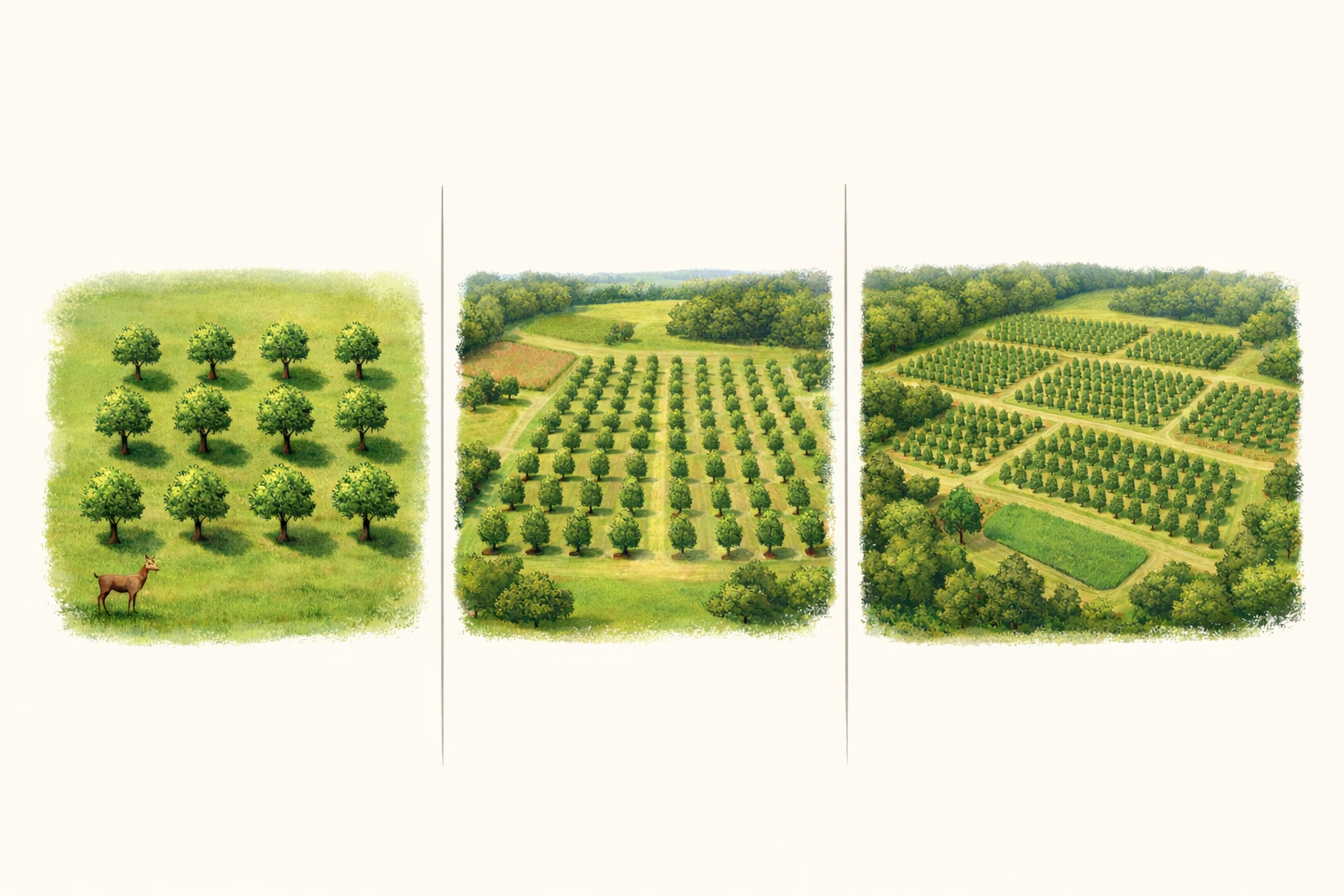
If you read our last post on patterning deer with a hunting orchard, you're probably already thinking about your land - where the deer move, where they bed, and where a well-placed tree might change everything. This post is the practical follow-up: three planting templates you can adapt to your property, whether you're starting with a corner of a field or redesigning a full parcel. A separate post will cover how to plant and establish the trees themselves. This one is about design.
A note before we get into the plans. None of these are rigid blueprints. Deer behavior, terrain, existing cover, and your hunting setup all matter more than any grid on paper. Use these as starting points, not prescriptions. And don't feel pressure to start big. One of the best approaches for any property is to plant a modest first orchard, watch how deer respond across two or three seasons, and expand from there. Trees are a long game. Let the deer tell you what's working.
Starting from Scratch: Find Your Beachhead
If you're working with open agricultural land - corn and bean country, a pasture, or any large open parcel - don't try to redesign the whole property at once. Find an edge. A fenceline, a woodlot margin, a low corner that's always been awkward to farm. That's your beachhead. Establish your first orchard block there, let the trees begin to produce, and watch where deer start anchoring.
A productive chestnut and persimmon planting on the corner of a 100-acre farm will pull deer from across the property and measurably change their patterns within a few seasons. Start there, then build outward. The orchard doesn't need to be large to be effective - it needs to offer something the surrounding landscape doesn't.
Spacing, Alleys, and Your Traditional Food Plot
One of the most important design decisions you'll make is how much space to leave between rows - and that decision is mostly about how long you want to keep running a traditional food plot alongside your orchard.
Here's the reality of a maturing orchard: in the early years, there's plenty of light in the alleys. A young chestnut at year two takes up almost no canopy footprint, and you can run clover, brassicas, or a seed drill through the alleys just like any other food plot. That window lasts longer than most people expect - a decade or more at 40-foot row spacing. But as the trees grow, canopy begins to close and light on the ground decreases. The alleys gradually transition from productive food plot to mowed grass to eventual understory.
If you want to maintain a permanent food plot corridor as a long-term part of the design - not just for the establishment years, but indefinitely - the solution is simple: leave one row out.
On a 40-foot row spacing plan, skipping one row creates an 80-foot open corridor. That's enough width to maintain good light penetration for an annual plot even as adjacent trees reach maturity. On a 5-acre plan you might alternate: two chestnut rows, one open corridor, two chestnut rows, and so on. The open corridor stays in clover or gets tilled and seeded each year. The tree rows do their work on either side.
You can also go wider by design from the start. At 80-100 feet between rows, you preserve enough ground for indefinite tillage and seed-drill access. The tradeoff is fewer trees per acre and a longer wait before the site feels like an orchard rather than a field with some saplings in it. Both approaches are valid - it just depends on whether you're a food plot person first who wants to add trees, or an orchard person first who wants to preserve some open ground.
A Note on Mowing and Invasive Management
In Ohio and the surrounding region, a planted orchard without a mowing strategy is a future thicket. Multiflora rose, honeysuckle, Bradford pear, and other invasive woody shrubs will colonize any opening you create, and they will do it fast. The best defense is a grid layout that allows you to run a mower down every row at least once a year - typically in late winter when you can see what you're doing and the ground is firm.
This is one of the most practical reasons to plant in straight rows at consistent spacing rather than naturalistic clusters: mowability. Whatever plan you choose, make sure your row spacing accommodates the equipment you'll use to maintain it, and design the grid so no tree gets accidentally taken out during a winter mow. A simple stake and flagging system on young trees goes a long way.
A Note on Cross-Pollination
Apples require at least two trees of different varieties to cross-pollinate and produce fruit reliably. A single apple tree will underperform. Plant at least two, and ideally mix early and late-ripening varieties to extend the drop window. The same principle applies to pawpaws, which need two genetically distinct individuals - a clonal patch from the same root system won't pollinate itself. Chestnuts, persimmons, pears, oaks, and pecans are more forgiving, but diversity always improves production.
Plan 1: The 10-Tree Starter
Ten trees won't feed a whole deer herd. They will create a pattern where none existed before - one reliable food source that pulls deer to a specific spot, at a specific time, that you can hunt. Think of this as your proof of concept: do it well, watch the deer respond over a season or two, and you'll know exactly where to go next.
Recommended mix:
4 chestnuts (anchor - September-October hard mast, exceptional draw for pre-rut bucks)
2 persimmons (rut and late-season carry, October-December)
2 pears, different varieties (early soft mast, August-October; two required for cross-pollination)
2 apples, different varieties (summer through early fall draw; two required for cross-pollination)
Layout: Plant the chestnuts in a short row or loose cluster at the back of your opening, 40 feet apart. Persimmons go on the downwind side - deer approaching to feed will hit their scent before reaching your stand. Pears and apples go along the entry side or field edge, giving deer an early-season reason to visit and build a habit well before chestnuts drop in September.
This plan fits comfortably along 200 feet of a field edge or woodlot margin, or in a roughly 150x150-foot clearing. No complicated grid required at this scale - just keep trees far enough apart that you can mow between them.
Stand placement: One stand on the downwind edge of the chestnut cluster covers the primary draw in October. A second location covering the entry-side pears and apples handles early-season bowhunting in August and September.
Plan 2: The 1-Acre Orchard
One acre (roughly 209x209 feet) is enough to build a genuine destination - a place deer don't just pass through but actively seek out and return to across the full season. At this scale the grid matters, both for production and for the mowing management that keeps the site clean.
Option A: Pure Chestnut at 40x20, Thin to 40x40
Plant chestnuts on a 40x20 grid - 40 feet between rows, 20 feet between trees within each row. On one acre this gives you 5 rows of 10 trees: 50 trees total.
This is a deliberately dense start. Closer spacing gets trees into production faster, creates earlier competition that drives upward growth, and gives you more trees producing nuts in the critical years 3-8 before any individual tree has reached full size. The plan is to thin to a 40x40 grid somewhere between year 12 and year 18, when crowding begins to limit production. At that point you remove every other tree in the row, dropping to 25 trees - each with full room to spread to mature canopy. The trees you remove by then will be substantial, and the wood has real value.
You end up with a mature orchard at ideal 40x40 spacing without having waited 20 years for a sparser planting to fill in.
This is the simplest plan, the fastest path to production, and the least complexity to manage. If you're new to orcharding and want a clear starting point, this is it.
Option B: Alternating Rows - Chestnut/Pawpaw + Mixed Fruit and Nut
Same 40x20 grid, same 50-tree total, but with seasonal diversity built into the layout from the start.
Odd rows are chestnut primary, with a pawpaw inserted between each chestnut - giving an effective 10-foot within-row spacing in those rows. Even rows carry your mixed soft mast species: apples, pears, persimmons, and pecans at 20-foot spacing.
On one acre this looks like:
3 chestnut/pawpaw rows: roughly 30 chestnuts and 20 pawpaws
2 mixed fruit/nut rows: 20 trees mixing apple, pear, persimmon, and pecan (at least 2 apples and 2 pears for cross-pollination)
The result is a site that produces from August through December across the full seasonal calendar - soft mast pulling deer in late summer, hard mast anchoring them through pre-rut, persimmons and pecans carrying the late season. The tradeoff is more upfront complexity and a higher tree cost. This plan suits someone who wants a single permanent orchard block that covers the whole season without expanding in phases.
A practical note on the pawpaw rows: deer generally avoid pawpaw foliage and bark due to natural compounds in the plant, which means young pawpaw trees establish with much less browsing pressure than chestnuts or apples. This makes them a lower-maintenance component of the interplant during the establishment years.
Stand placement for either option: One stand on the downwind side of the chestnut rows covers the primary October draw. A second location on the entry side covers early-season apple and pear activity if the site shape allows.
Plan 3: The 5-Acre System
At five acres you're building a landscape that anchors deer to your property from August through December. This is less a single food plot and more a multi-zone system developed across several years.
The core design principle: zone by season, with high-value hard mast in the interior and soft mast species on the edges and entry corridors. Plant in phases - the core first, edges second, late-season zone third.
Zone 1 - Entry and Early Season (August-October): Apples and pears planted along the primary travel corridor or field edge deer use to approach the property. 8-10 trees, mixed varieties for a long drop window. These establish the habit early. Deer start visiting in August, build a pattern, and are already anchored to the site by the time chestnuts drop in September. This is how you get daylight movement on your property before opening day.
Zone 2 - Core Hard Mast Block (September-November): Two to three acres of chestnuts in the interior, planted at 40x20 and thinned to 40x40 at maturity. At 40x20, three acres holds roughly 160 chestnuts - plant this in phases across two or three springs if that number feels like too much at once. The alternating-row option works well at this scale too: chestnut/pawpaw rows alternating with rows of oak and pecan, layering hard mast species that extend the drop window from September through late November.
If you want to maintain permanent food plot corridors within the orchard as it matures, leave one 40-foot row slot open as a permanent alley every few rows. That 80-foot open corridor will hold enough light for productive annual plots even as adjacent trees reach maturity. You get the best of both systems indefinitely.
Zone 3 - Rut and Late Season (October-December): Persimmons, oaks, and pecans clustered at the far end of the property from your main entry. Plant in loose clusters of 4-6 trees rather than strict rows to mimic natural mast patches. Persimmons are your most reliable late-season anchor - still dropping sweet fruit in November and December when everything else is gone. This is where you want your rut stand.
Phased planting:
Year 1: Plant the chestnut core (Zone 2). Longest to produce, highest value.
Year 2: Add entry-side apples and pears (Zone 1).
Year 3: Add late-season persimmons, oaks, and pecans (Zone 3).
By the time chestnuts begin producing in year 4-5, the full seasonal system is established and working.
Tree count summary:
Zone
Species
Trees
Zone 1 - Entry
Apple, Pear
8-10
Zone 2 - Core
Chestnut (+ optional Pawpaw)
80-160
Zone 3 - Late season
Persimmon, Oak, Pecan
12-18
Total
100-190, over 2-3 years
Start Small, Think Long
Every one of these plans is a starting point. The 10-tree planting becomes the nucleus of a 1-acre orchard. The 1-acre orchard becomes Zone 2 of a 5-acre system. Plant what you can manage well, watch how deer respond, and let success tell you where to go next.
The trees in these plans - chestnut, pawpaw, persimmon, apple, pear, oak, and pecan - are all available from Deer Orchard as bare-root seedlings this spring. Our next post covers how to plant and establish them: soil prep, protection, spacing stakes, and the first-year care that separates a thriving tree from a struggling one.