How to Plant Your Hunting Orchard: From Grid Layout to Tree in the Ground

The last two posts covered why to build a hunting orchard and how to design one. This one is about actually doing it. We'll walk through site prep, laying out your grid in the field, planting the trees, and protecting them so they have a real chance to establish. A future post will cover first-year and ongoing care. This one gets you through planting day.
Before You Plant: Think About Your Soil
You don't need perfect soil to grow a successful hunting orchard. But you do need soil that lets roots move. The most common limiting factor on agricultural and pasture ground in the Midwest isn't fertility - it's compaction. Years of tillage equipment, field traffic, and grazing create a hardpan layer that roots hit like a ceiling, restricting growth and forcing trees to struggle for water and nutrients that are right there, just out of reach.
Before you plant, it's worth knowing what you're working with. Push a long screwdriver or a soil probe into the ground and note where it gets hard. If you hit serious resistance at 8-10 inches, you've got a compaction issue worth addressing.
If you have access to a subsoiler or chisel plow, use it. Run it down each planned tree row before planting. Subsoiling opens furrows to a depth of 15 inches or more, increasing aeration and water-holding capacity and breaking up root-restricting hardpan from years of tillage and field traffic. At our 25-acre Southern Ohio Chestnut Company (SOCC) site in Athens County, we flagged the rows at 40-foot spacing and ran a subsoil ripper down each one before planting. The difference in early tree establishment was noticeable - roots had somewhere to go from day one.
Ripping is most effective when soils are dry - this is when fracturing the pan has the greatest impact and the broken structure holds longest. Don't rip wet ground. You'll smear more than you'll fracture.
If you have time before planting - even one season - consider a cover crop on the site. Deep-rooted cover crops like sorghum sudangrass or daikon radish help penetrate compacted layers biologically, preparing the soil for root growth without mechanical intervention. Radish in particular punches through compaction with its large taproot, then decomposes over winter and leaves channels for tree roots to follow in spring. It's not a replacement for subsoiling on heavily compacted ground, but it's a meaningful improvement for lighter situations and adds organic matter in the process.
A note on soil pH - especially for chestnuts. Before you order trees, run a soil test. Chestnuts require a pH of 6.5 or lower. If your test comes back high, we'd love to sell you trees, but they're destined to struggle. Don't bother with chestnuts on high-pH ground until you've addressed it.
Our SOCC site is a good example of how this plays out. Initial soil tests came back with elevated pH, but Web Soil Survey suggested we had silty loam soils that should have been naturally acidic. Once we dug into it, we realized the previous owners had limed the pasture fields for years - the surface layer was alkaline, but the deeper legacy soils were right where they needed to be. We amended with a few tablespoons of granulated sulfur per tree to help roots push through the limed surface layer, and the trees have done fine. The lesson: if your surface test comes back high but your site history or Web Soil Survey suggests it shouldn't be, test at deeper layers before you write off the site. And if sulfur amendment is warranted, a small amount per tree goes a long way.
Laying Out Your Grid
Getting your rows straight and your tree spacing consistent matters more than most people expect - not because trees care about geometry, but because you do. A well-laid grid is one you can mow, manage, and navigate for the next twenty years. A sloppy one becomes a problem the first time you try to run equipment through it.
Think about it the way you would laying out a tile job. Find a clean baseline - a fence line, a field edge, a road - and work from there.
Here's the field method we use:
Flag your rows. Measure out row intervals along the baseline - 40 feet for a tight production grid, wider if you're maintaining food plot alleys - and mark each row start with a flag. Space flags far enough into the field that you can see the line from a tractor cab.
Subsoil the rows. Run the subsoiler down each flagged row line. The rip line itself becomes your row marker on the ground.
Set your within-row spacing using a fixed-length tool. This is where a cut piece of PVC pipe beats a tape measure every time. We use a 10-foot length of PVC to step off each tree position within the row. One person holds the back end at the last stake, the other walks to the front, drops a flag, and hands the pipe back. Fast, consistent, no math required on the day of planting. Adjust pipe length to match your spacing - 20-foot spacing means leapfrogging the pipe twice per position.
Check your grid with triangulation. Before you start digging, pull a diagonal from one corner of the block to the opposite corner and compare it to your plan. For squaring corners, a 3-4-5 right triangle works: if your baseline is 40 feet and your perpendicular is 30 feet, the diagonal should be 50 feet. Two people with a long tape can check a large block quickly. Catch drift here, before you've committed to digging.
Planting the Tree
Bare-root trees are what Deer Orchard sells, and they're what most hunting orchard plantings use. They're cheaper, easier to handle in volume, and when planted correctly establish just as well or better than container stock. The window for bare-root planting is tight - trees need to go in the ground while dormant, before bud break. In Ohio that means March through end of April at the latest. Earlier is better - a tree planted in March has weeks of cool moist soil to regenerate its root system before bud break, while one planted in late April is racing the calendar. Get them in the ground as soon as soil conditions allow.
Before planting day:
Keep bare-root trees cool, moist, and out of direct sun until you're ready. A cool garage with roots wrapped in damp burlap or cardboard is fine for a few days.
Shortly before planting - 15 minutes to a few hours, not overnight - soak the roots in a bucket of water. Longer than a few hours and you start depriving roots of oxygen, which defeats the purpose.
Add a packet of mycorrhizal inoculant (we use MycoApply) to the soak water right before the trees go in. Skip the overpriced individual tree packets sold at nurseries - buy a package, add it to your bucket, and inoculate every tree at once. This one addition measurably improves establishment and costs almost nothing at scale.
Trim off any broken, dead, or twisted roots with clean pruners before the tree goes in the hole.
Digging the hole:
A soil auger - whether a tractor-mounted attachment or a handheld two-person unit - is a common planting tool, but use it in combination with subsoiling, not instead of it. Subsoil the row first, then auger your planting holes. Glazing can occur on the sidewall of an augered hole, sealing it and restricting outward root growth - rough up the sidewall with a shovel after drilling, or use a bit with a scarifier on the edge. Subsoiling first gives roots somewhere to go once they push past the planting hole wall.
Dig or auger the hole wide enough that roots spread naturally without bending, and deep enough that the trunk flare sits at or just above the surrounding soil surface. Plant slightly high rather than slightly deep - augered holes tend to settle after rain and irrigation, and a tree that sinks an inch or two below grade is in trouble.
Setting the tree:
Build a small cone of soil in the center of the hole, drape the roots over it evenly, check your depth, and backfill with native soil broken into fine clods. Firm in layers with your hands to eliminate air pockets. On grafted trees - apples, pears - keep the graft union 3-4 inches above the soil surface. Water deeply immediately after planting.
Weed suppression at the base:
Keeping weeds and grass away from the base of a young tree is the single most impactful thing you can do for establishment. Grass competition for moisture in the first season can stall a tree that would otherwise thrive. Our preferred method is black plastic mulch mat laid at the time of planting. It eliminates competition completely, retains moisture, and lasts multiple seasons with minimal maintenance. If you have wood chip mulch available, a 3-4 inch ring 18-24 inches in diameter works as well - keep it a few inches off the trunk. Whatever you use, don't skip this step.
Tree Protection
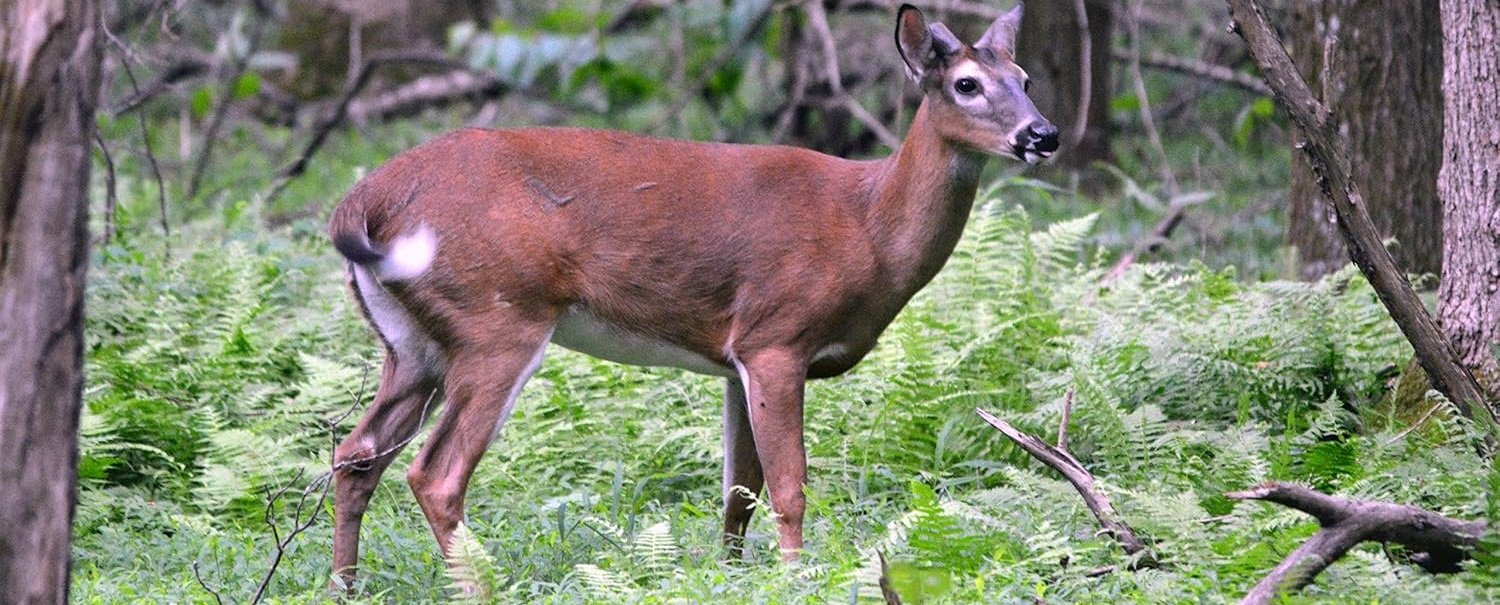
This is where a lot of hunting orchard plantings fail - not at planting, but in the months after, when deer find your investment. Protection is not optional.
We've planted over 2,500 trees across multiple sites and tried a lot of approaches. The only protection system we can recommend without reservation is Plantra tree tubes. For the combination of labor, cost, and effectiveness, nothing else comes close. Don't waste time jerry-rigging chicken wire or building individual cages. Get the right protector, install it correctly, and move on. Every hour spent on improvised protection is an hour that could go toward planting more trees.
Two scientific studies at Auburn University found nearly double the survival rate and double to triple the vertical growth rate in tube-protected seedlings compared to unprotected ones. Beyond browse protection, the tube creates a greenhouse microclimate that drives upward growth and forces the tree above deer reach faster than it would grow in the open. It also protects the stem from herbicide drift during your annual mow passes - which matters every year.
On tube height: use 5-foot tubes as your standard. If you have intense deer pressure on your property, go to 6 feet. Whitetails browse at up to 4.5 feet, and a tube that doesn't clear that height is not doing its full job.
Keep the tree staked for a few months after tube removal - the trunk needs time to adjust to wind load after growing in a protected environment.
The Day of Planting
Have everything staged before the first tree goes in: trees soaked and mycorrhizae added, holes flagged, tubes and stakes on site, mulch mat cut and ready. The actual planting sequence - hole, tree, backfill, water, mulch mat, tube - moves fast once you have a rhythm.
With a team of two or more working together, expect roughly 6 trees per person per hour when including all amendments, weed mat, and tube installation. That's a useful number for planning your day and deciding how much to tackle in a single session.
Plant in the morning, water before you leave or plan for rain soon, and come back in two weeks to check that nothing has heaved, listed, or been found by deer before the tubes went on. The first 60 days are when most failures happen and most of them are preventable.